
-
Before advice: Advice that executes before a join point, but which does not have the ability to prevent execution flow proceeding to the join point (unless it throws an exception).
-
After returning advice: Advice to be executed after a join point completes normally: for example, if a method returns without throwing an exception.
-
After throwing advice: Advice to be executed if a method exits by throwing an exception.
-
After (finally) advice: Advice to be executed regardless of the means by which a join point exits (normal or exceptional return).
-
Around advice: Advice that surrounds a join point such as a method invocation. This is the most powerful kind of advice. Around advice can perform custom behavior before and after the method invocation. It is also responsible for choosing whether to proceed to the join point or to shortcut the advised method execution by returning its own return value or throwing an exception.
Compass : now with more features…
Compass is a first class open source Java Search Engine Framework, enabling the power of Search Engine semantics to your application stack decoratively. Built on top of the amazing Lucene Search Engine, Compass integrates seamlessly to popular development frameworks like Hibernate and Spring. Now in the latest release Compass 1.2, they are providing search capabilities for object models also. Compass allows to map your domain model (Object, pure XML, and the map like Compass Resource) into the search engine simply using either xml or annotations, and integrates with leading ORM libraries (Hibernate, TopLink, OpenJPA) and web frameworks (Spring MVC, Grails) in order to simplify even more the introduction of search into an application.
When we started to work with Compass [with Spring framework and Hibernate and months before the release of Hibernate search] there were no good documentations at all about it. that time we want to use Lucene for our full text search purpose. But because of the complexity of Lucene integration we used Compass as a Mapping framework between Spring and Lucene. My friend Roshan had done a lot of efforts to complete that successfully. Only one or two examples are the guidelines for him. Now Compass is improved a lot. It has a well prepared documentation [ style is looking like Spring’s official documentation], more examples, more and more features… and …. Now Hibernate search is also came to help us for full text search in a great and easy way.
Technorati Tags: Spring , Spring Framework , Compass , Lucene , Hibernate , Search
Compass Framework Modules
” Excerpted from Compass official Documentation.
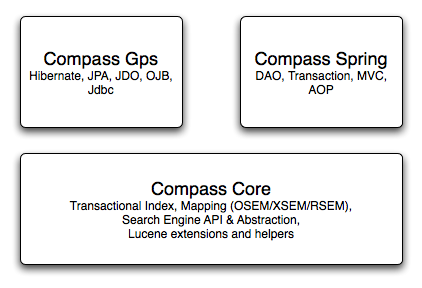
Compass Core is the most fundamental part of Compass. It holds Lucene extensions for transactional index, search engine abstraction, ORM like API, transaction management integration, different mappings technologies (OSEM, XSEM and RSEM), and more. The aim of Compass core is to be usable within different scenarios and environments, and simplify the core operations done with a search engine.Compass Gps aim is to integrate with different content sources. The prime feature is the integration with different ORM frameworks (Hibernate, JPA, JDO, OJB), allowing for almost transparent integration between a search engine and an ORM view of content that resides in a database. Other features include a Jdbc integration, which allows to index database content using configurable SQL expression responsible for extracting the content.Compass Spring integrate Compass with the Spring Framework. Spring, being an easy to use application framework, provides a simpler development model (based on dependency injection and much more). Compass integrates with Spring in the same manner ORM Frameworks integration is done within the Spring Framework code-base. It also integrates with Spring transaction abstraction layer, AOP support, and MVC library.
How Google Calculates the Page Rank?
Factors that can increase your Google PageRankNow the Google PageRank algorithm can be very complexed, but yet friendly invention. Here is a list of things that could help boost you Google PageRank, with a rating scale beside it of how important we think it is.
- Update Pages Frequently 2/10
- Add Pages Frequently 4/10
- Good Neighborhood Directories with high PageRank Levels 7/10
- Monster Websites 7/10
- Quality Inbound links 8/10
- Quality Relevant Links 9/10
- No Broken Links 5/10
- Article Submissions (this can increase your PageRank by getting more inbound links)
- All these put together 10/10
Factors that can decrease your Google PageRank
- Bad inbound links such as Poker, Sex, Drugs, or anything to that nature
- Link spamming
- Bad Content
- Lots of broken links
- SEO Black Hat Techniques
This info. is taken from Devon’s Blog. You can visit his site for more information about the Algorithm of Google and many more…
Technorati Tags: Google , Page Rank , Search Engines
 Orange Slate